Read the Final Report and Executive Summary of Task 41 here: https://iea-es.org/publications/type/final-reports
Evaluating the economics of energy storage systems
What is the value of energy storage in certain applications and how can it be quantified? How can the benefits and value of energy storage be translated into promising business cases?
In the course of the Task EcoEneSto, a coordinated assessment of the economic viability of energy storage in all applications relevant to the energy system was carried out. Different methodological approaches and all energy storage technologies (electrical, thermal, and chemical) were considered. The basis was an inventory of economically interesting energy storage configurations and the derivation of preferred conditions (technical and non-technical) for energy storage operation.

The objectives of the proposed Task were:
- Collection of methods to evaluate the economic viability of energy storage systems for specific applications
- Definition of key performance indicators (KPIs) to evaluate the economics of energy storage
- Inventory of economically interesting energy storage configurations and deriving preferable conditions for energy storage operation in actual applications (technical and non-technical)
- Identification of difficult cases in which existing benefits of energy storage solutions cannot be transferred into possible business cases
- Comparison of energy storage configurations to solutions with other flexibility measures and to systems without energy storage
- Analysis of the influence of regulatory framework conditions on possible energy storage business cases by listing specific examples
- Establish a framework for the development of business cases for energy storage
The Task EcoEneSto was divided in four Subtasks:

Maximum acceptable storage capacity costs
A simple methodology has been developed for the economic evaluation of energy storage systems for a specific user and application. The economic evaluation is based on the assumption that the cost of energy from the storage system must not exceed the cost of an alternative energy supply. Following this assumption, the maximum acceptable storage capacity costs (SCCacc) are calculated from the interest rate assigned to the capital costs, the intended payback period of the user, the costs of energy from the market, and the annual number of storage cycles (Ncycle).
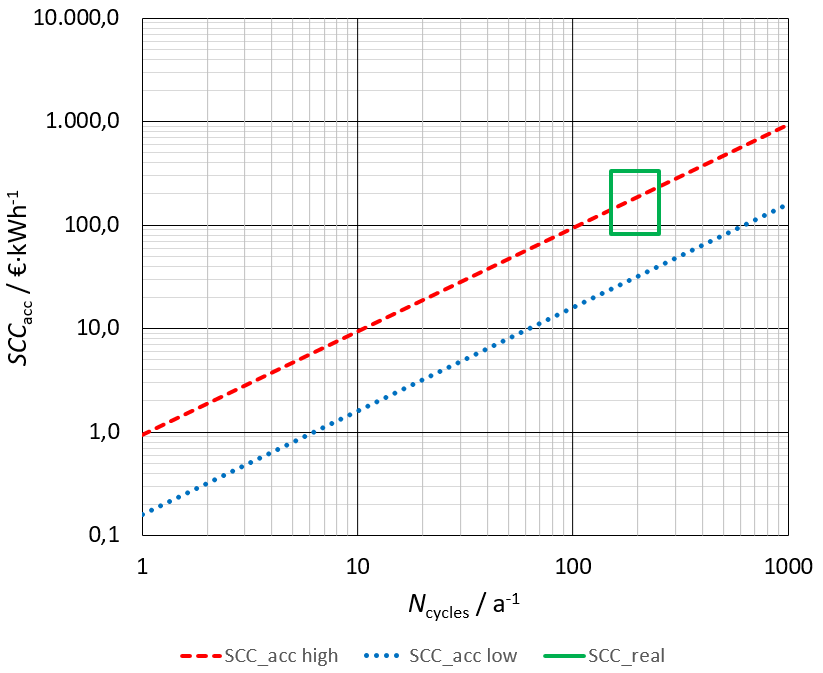
Three different approaches are available. Two of the approaches are particularly suitable when the main purpose of the energy storage system is to supply a certain amount of energy and thus reduce the use of alternative energy sources. The third approach is advantageous when considering different sources of income, i.e. when the implementation of a storage system in an application brings several advantages and resulting revenues.
An Excel tool has been developed to apply the three approaches:
This tool is explained in section 7 of the final report of Task 41: https://iea-es.org/publications/final-report-task-41-economics-of-energy-storage/
When using the tool and publishing data or figures calculated or created with the tool, please include the following citation:
Energy Storage TCP (2026): ES TCP Task 41 Economic Assesment Tool. Excel file. Available at: https://iea-es.org/task-41/, accessed [DATE].